The new Keyword in JavaScript — From Confusion to Clarity.
If you've ever written JavaScript like this:
function User(name) {
  this.name = name;
}

const u1 = new User("Chitta");
…and thought:
"What exactly is
newdoing behind the scenes?"
You're not alone.
Most developers use new — but very few truly understand it deeply.
This blog will break it down in a step-by-step, visual, and practical way so that you can confidently explain it in interviews and use it in real-world systems.
Why the new Keyword Matters
Before understanding how, let’s understand why.
Without new, JavaScript objects would be harder to structure and reuse.
new helps you:
Create multiple objects from a template
Use object-oriented patterns
Reuse logic efficiently
Link objects with shared behavior (via prototypes)
What the new Keyword Does (In One Line)
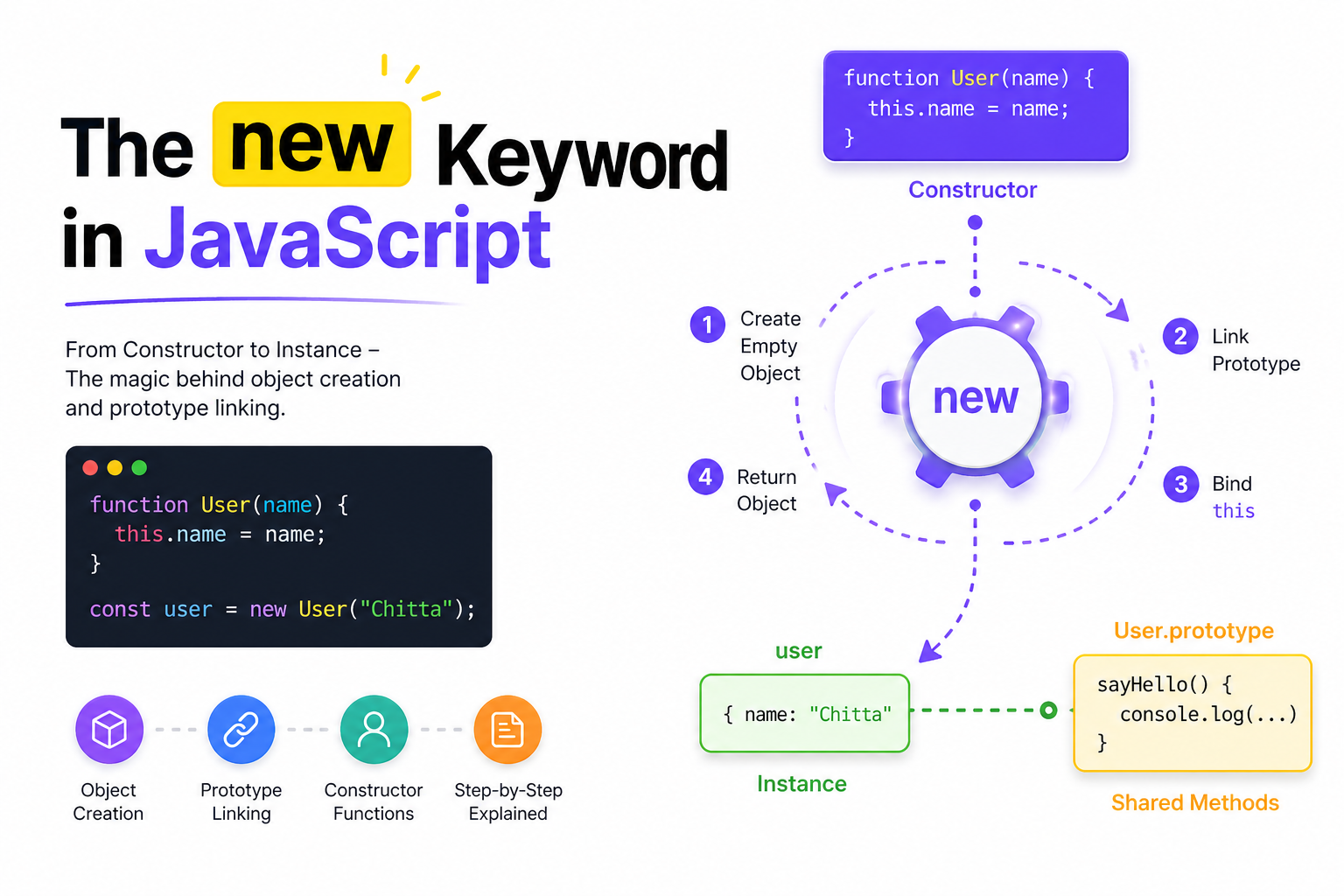
The new keyword creates a new object and connects it to a constructor function and its prototype.
But that's just the surface.
Let’s break it down properly.
Step-by-Step: What Happens When You Use new
When you run:
const user = new User("Chitta");
JavaScript internally performs 4 steps:
Step 1: Create an Empty Object
const obj = {};
Step 2: Link Prototype
obj.__proto__ = User.prototype;
This is the most important step.
Step 3: Bind this
User.call(obj, "Chitta");
Now inside the constructor:
this.name = "Chitta";
Step 4: Return the Object
return obj;
Unless you explicitly return another object.
Visual Flow of new


Constructor Functions (The Foundation)
A constructor is just a regular function, but with a convention:
Starts with a capital letter
Uses
thisto assign properties
function Car(brand, model) {
  this.brand = brand;
  this.model = model;
}
Creating Instances
const car1 = new Car("Tesla", "Model 3");
const car2 = new Car("BMW", "X5");
Each call creates a new independent object.
Important Insight
Without new, the same function behaves completely differently.
const car = Car("Tesla", "Model 3");
console.log(car); // undefined
Why?
Because:
thiswill point to global object (or undefined in strict mode)No object is created
Understanding Prototype Linking
This is where things get powerful.
function User(name) {
  this.name = name;
}

User.prototype.sayHello = function () {
  console.log("Hello " + this.name);
};
const u1 = new User("Chitta");
u1.sayHello(); // Hello Chitta
What’s Happening?
u1does NOT havesayHelloJavaScript looks into
User.prototypeFinds the method there
Prototype Linking Visual


Key Takeaway
newconnects your object to shared methods using prototypes.
This is memory efficient.
Instead of duplicating methods:
- One method → shared across all instances
Instance Creation Deep Dive
Let’s inspect:
console.log(u1);
Output:
User { name: "Chitta" }
Now check:
console.log(u1.__proto__ === User.prototype); // true
Constructor vs Instance Relationship
| Concept | Meaning |
|---|---|
| Constructor | Blueprint function |
| Instance | Actual object created |
| Prototype | Shared methods storage |
Internal Working Simulation
Let’s recreate new manually:
function myNew(constructor, ...args) {
  const obj = {};
  obj.__proto__ = constructor.prototype;

  const result = constructor.apply(obj, args);

  return result instanceof Object ? result : obj;
}
Usage
const u2 = myNew(User, "Rahul");
console.log(u2);
Now you understand:
newis not magic — it’s just a structured process.
Constructor Returning Values (Edge Case)
function Test() {
  this.name = "Default";
  return { name: "Override" };
}

const t = new Test();
console.log(t.name); // Override
Rule
If constructor returns object → that object is returned
If it returns primitive → ignored
Real-World Use Case
You’ll see new used in:
Object-oriented systems
Libraries
Design patterns
Older JavaScript codebases
Example:
const date = new Date();
Behind the Scenes (Animation Understanding)


Common Mistakes
1. Forgetting new
const user = User("Chitta"); // wrong
2. Using Arrow Functions as Constructors
const User = (name) => {
  this.name = name;
};

new User("Chitta"); // ❌ Error
Arrow functions:
Do NOT have
thisCannot be used with
new
3. Overusing Constructors Instead of Classes
Modern JavaScript prefers:
class User {
  constructor(name) {
    this.name = name;
  }
}
But internally — it still uses new.
Advanced Insight (Interview Level)
new Creates Hidden Links
Internal
[[Prototype]]constructorreferenceDynamic
thisbinding
Prototype Chain Lookup
When you do:
u1.sayHello()
JS checks:
Inside
u1Then
u1.__proto__Then higher chain
Mental Model (Most Important)
Think like this:
Constructor = Blueprint Prototype = Shared Brain Instance = Real Object new = Factory Machine
Final Summary
newcreates a fresh objectLinks it to a constructor’s prototype
Binds
thisto that objectReturns the object automatically
One-Line Definition (Interview Ready)
The
newkeyword creates an object, links it to a constructor’s prototype, bindsthis, and returns the instance.
Closing Thought
Most developers memorize new.
Top developers understand it deeply.
Once you get this:
Prototypes become easy
Classes make sense
JavaScript feels less "weird"


