How Node.js Handles Multiple Requests with a Single Thread
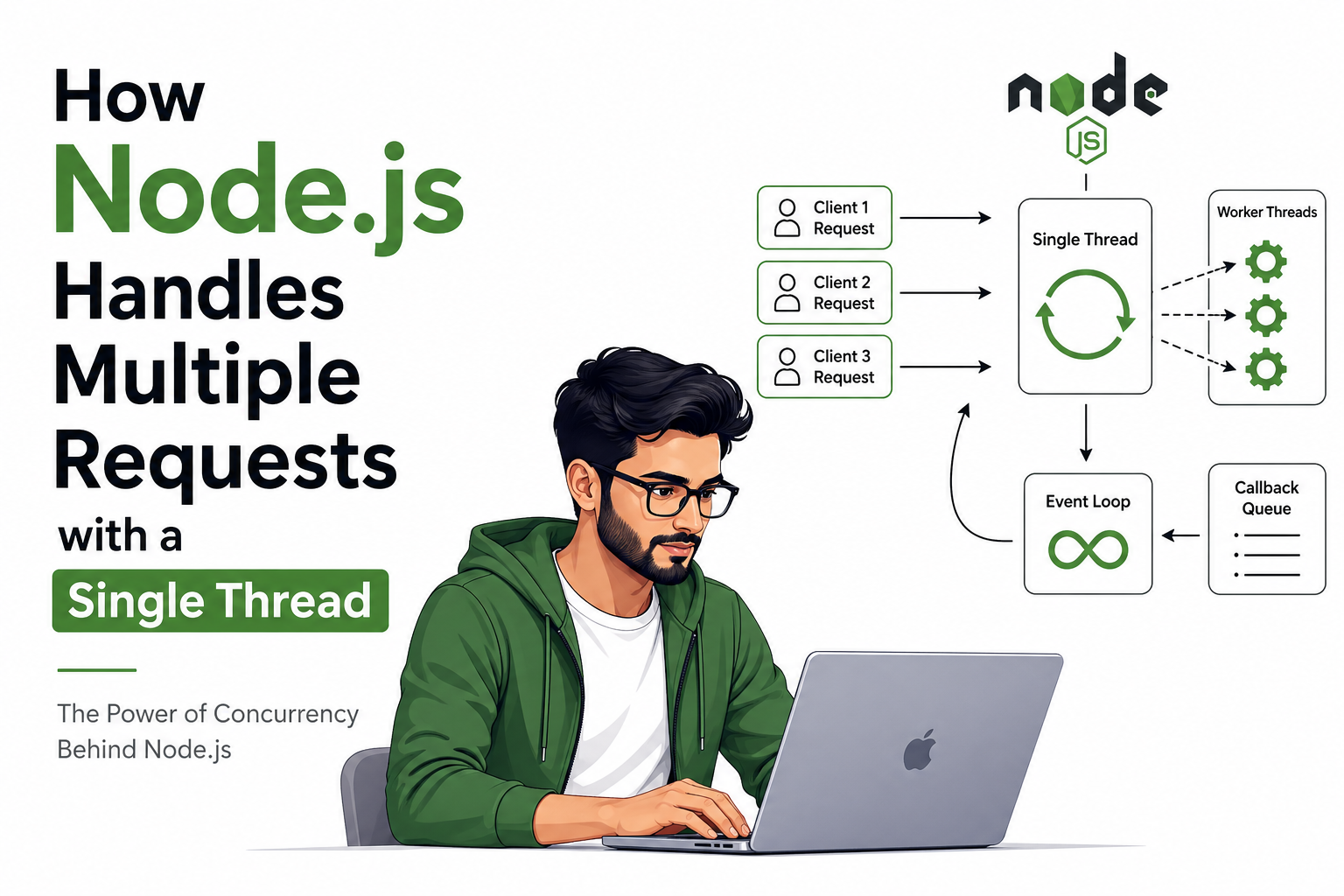
Modern web applications serve thousands — sometimes millions — of users at the same time. At first glance, this seems impossible for a system that runs on a single thread. Yet Node.js does exactly that.
This article breaks down how Node.js handles multiple requests efficiently, without spawning new threads for each user, and why this design makes it incredibly scalable.
The Big Question
How can a single-threaded system handle multiple requests simultaneously?
The answer lies in concurrency, not parallelism.
Before we go deeper, let’s build a simple mental model.
Thread vs Process (Simple Understanding)
Process → A full application instance (heavyweight)
Thread → A unit of execution inside a process (lightweight)
Traditional servers (like Java or PHP-based systems) often use:
One thread per request
More users → More threads → More memory usage
Node.js does something different:
Uses one thread
Handles many requests using non-blocking operations
Real-Life Analogy: The Chef Handling Orders
Imagine a restaurant kitchen:
One chef
Many customers placing orders
Traditional Model (Multi-threaded)
Each order gets a separate chef → More chefs = more cost and coordination
Node.js Model (Single-threaded)
One chef:
Takes an order
Starts cooking
If something takes time (like baking), delegates it
Moves to the next order
This is exactly how Node.js works.
Single-Threaded Nature of Node.js
Node.js runs JavaScript in a single main thread.
That means:
Only one piece of JavaScript runs at a time
No thread switching overhead
Simpler execution model
But this raises a concern:
What happens when a task takes time (like reading a file or calling an API)?
The Event Loop: The Heart of Node.js


The event loop is what allows Node.js to handle multiple operations efficiently.
What it does:
Continuously checks if there are tasks to execute
Picks tasks from a queue
Executes them one by one
Key Idea:
The event loop does not wait for slow operations.
How Node.js Avoids Blocking
Let’s say a user requests data from a database.
In a blocking system:
Request comes
Thread waits for DB response
No other request handled during that time
In Node.js:
Request comes
DB query is sent
Task is delegated to background
Node moves to next request immediately
When response is ready → callback is executed
Delegating Work to Background Workers
Node.js internally uses:
libuv
Thread pool (background workers)
These workers handle:
File system operations
Network requests
Database calls
Main thread stays free.
Flow of a Request in Node.js


Step-by-step:
Client sends request
Node.js receives it
If task is fast → execute immediately
If task is slow → delegate to worker
Event loop continues processing other requests
Worker finishes task
Callback pushed to queue
Event loop executes callback
Response sent back
Handling Multiple Client Requests
Let’s imagine 3 users hitting your server at the same time:
User A → API call
User B → File read
User C → Simple response
What Node.js does:
Accepts all requests instantly
Sends A & B to background
Immediately responds to C
Later processes A and B when ready
No blocking. No waiting.
Concurrency vs Parallelism
This is where most people get confused.
Parallelism
Multiple tasks at the same time
Requires multiple threads/cores
Concurrency (Node.js)
Multiple tasks handled efficiently
Not necessarily at the same exact moment
Tasks are interleaved
Node.js is concurrent, not parallel (by default).
Why Node.js Scales So Well
1. No Thread Overhead
No need to create thousands of threads
Saves memory
2. Faster Context Switching
No thread switching
Event loop is lightweight
3. Efficient I/O Handling
Perfect for:
APIs
Real-time apps
Streaming services
4. High Throughput
- Can handle many connections simultaneously
When Node.js Might Not Be Ideal
Node.js is not perfect for everything.
Avoid it when:
Heavy CPU tasks (image processing, ML, etc.)
Long blocking computations
Because:
- It can block the main thread
Key Insight
Node.js is not about doing everything faster. It is about not waiting unnecessarily.
That’s the real power.
Visual Summary


Single thread handles logic
Background workers handle heavy tasks
Event loop manages execution flow
Final Thoughts
Node.js changed the way servers handle concurrency.
Instead of scaling by adding threads, it scales by:
Efficient scheduling
Non-blocking operations
Smart delegation
Once you understand the event loop, everything in Node.js starts making sense.
One-Line Takeaway
Node.js handles multiple requests with a single thread by delegating slow tasks and continuously processing the next available work through the event loop.


