Destructuring in JavaScript: From Syntax Sugar to Strategic Code Design
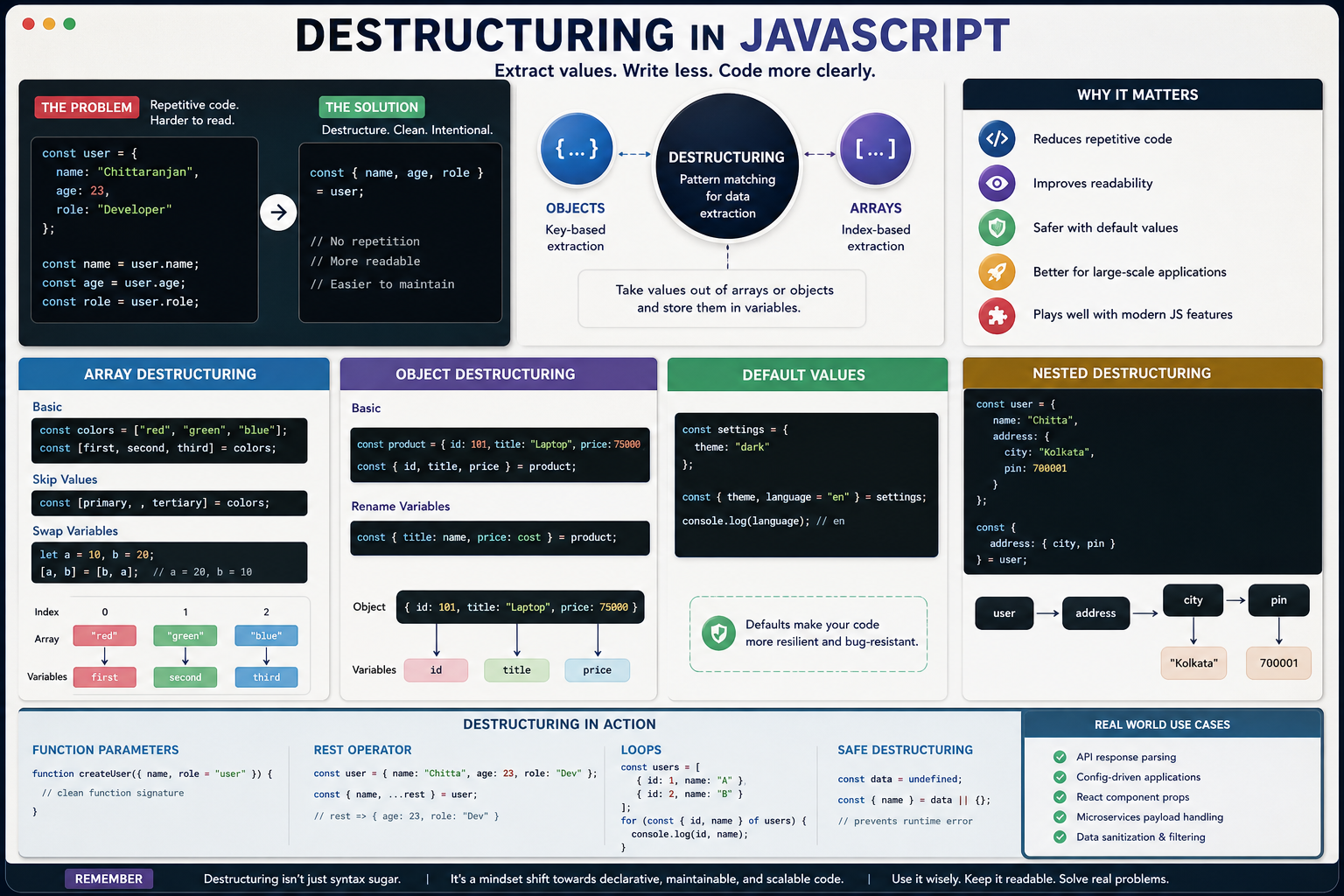
Modern JavaScript is not just about writing code that works — it's about writing code that communicates intent clearly, reduces cognitive load, and scales across systems. One of the most deceptively simple yet powerful features enabling this is destructuring.
At first glance, destructuring looks like syntactic sugar. In reality, it is a data extraction pattern that, when used properly, transforms how you structure functions, APIs, and even business logic.
This article goes beyond syntax. We will explore destructuring from fundamentals → patterns → architectural usage → production-level insights.
What Destructuring Really Means
Destructuring is a way to extract values from arrays or properties from objects into distinct variables.
Instead of manually accessing each value, you declare the structure you expect — and JavaScript maps values automatically.
Think of it as:
"Pattern matching for data extraction."
Why Destructuring Matters (Real Insight)
Before diving into syntax, understand the deeper value:
Reduces repetitive property access
Makes function signatures self-documenting
Encourages immutable data handling
Improves readability in large-scale applications
Enables cleaner integration with APIs and configs
The Problem It Solves (Before vs After)
Without Destructuring
const user = {
  name: "Chittaranjan",
  age: 23,
  role: "Developer"
};

const name = user.name;
const age = user.age;
const role = user.role;
With Destructuring
const { name, age, role } = user;
You eliminate repetition and express intent directly.
Visual Understanding: Object Extraction


This is not just shorthand — it's declarative data extraction.
Array Destructuring
Arrays rely on position-based extraction.
Basic Example
const colors = ["red", "green", "blue"];

const [first, second, third] = colors;

console.log(first); // red
console.log(second); // green
Skipping Values
const [primary, , tertiary] = colors;

console.log(tertiary); // blue
Swapping Variables (Classic Use Case)
let a = 10;
let b = 20;

[a, b] = [b, a];
No temporary variable needed.
Visual Understanding: Array Mapping


Arrays are about order, not names.
Object Destructuring
Objects rely on key-based extraction.
Basic Example
const product = {
  id: 101,
  title: "Laptop",
  price: 75000
};

const { id, title, price } = product;
Renaming Variables (Important in Real Projects)
const { title: productName, price: cost } = product;

console.log(productName); // Laptop
This is critical when working with APIs or conflicting variable names.
Default Values (Defensive Programming)
Destructuring allows fallback values.
const settings = {
  theme: "dark"
};

const { theme, language = "en" } = settings;

console.log(language); // en
Why This Matters
Prevents
undefinedbugsReduces conditional checks
Makes code resilient
Nested Destructuring (Where It Gets Powerful)
Real-world data is nested.
const user = {
  name: "Chitta",
  address: {
    city: "Kolkata",
    pin: 700001
  }
};

const {
  address: { city, pin }
} = user;

console.log(city); // Kolkata
Destructuring in Function Parameters
This is where destructuring becomes architectural.
Traditional Approach
function createUser(user) {
  const name = user.name;
  const age = user.age;
}
Destructured Function Parameters
function createUser({ name, age }) {
  console.log(name, age);
}
With Defaults
function createUser({ name, role = "user" }) {
  console.log(role);
}
Insight
This turns your function signature into a contract.
Real-World API Handling
const response = {
  status: 200,
  data: {
    user: {
      id: 1,
      name: "Chitta"
    }
  }
};

const {
  data: {
    user: { name }
  }
} = response;

console.log(name);
You extract deeply nested values in one line.
Destructuring + Rest Operator
Used for separating known vs unknown data.
const user = {
  name: "Chitta",
  age: 23,
  role: "Dev",
  salary: 50000
};

const { name, ...rest } = user;

console.log(rest);
// { age: 23, role: "Dev", salary: 50000 }
Business Use Case
Logging extra fields
Sanitizing user data
Filtering payloads
Destructuring in Loops
const users = [
  { id: 1, name: "A" },
  { id: 2, name: "B" }
];

for (const { id, name } of users) {
  console.log(id, name);
}
Cleaner iteration without repeated access.
Advanced Pattern: Safe Destructuring
Avoid runtime errors:
const data = undefined;

// Unsafe
// const { name } = data; ❌

// Safe
const { name } = data || {};
Subtle Pitfalls (Senior-Level Observations)
1. Destructuring Undefined
const { x } = undefined; // crashes
Always guard or default.
2. Performance Consideration
Destructuring creates variables — overusing it in tight loops can have slight overhead.
Use it wisely, not blindly.
3. Over-Destructuring
Avoid this:
const {
  a: {
    b: {
      c: {
        d
      }
    }
  }
} = obj;
Readable code matters more than compact code.
GIF: Destructuring Flow in Action

This shows how values are mapped dynamically at runtime.
Destructuring in Business-Level Code
Case: Config-Driven Systems
function initApp({ port = 3000, mode = "dev" }) {
  console.log(`Running on \({port} in \){mode}`);
}
Case: Microservices Payload Handling
function processOrder({ orderId, userId, items }) {
  // Direct access without deep referencing
}
Case: React (Real Industry Usage)
function UserCard({ name, role }) {
  return <div>{name}</div>;
}
Destructuring becomes standard practice.
Mental Model Upgrade
Stop thinking:
"Destructuring is syntax"
Start thinking:
"Destructuring is data pattern extraction"
Key Takeaways
Arrays → position-based extraction
Objects → key-based extraction
Defaults → safer code
Nested destructuring → powerful but should be readable
Functions + destructuring → cleaner APIs
Rest operator → flexible data handling
Final Thought
Destructuring is one of those features that looks simple early on, but becomes critical at scale. When used correctly, it shifts your code from imperative to declarative — from verbose to expressive.
The difference between average and senior-level JavaScript often lies in how data is handled, not just how logic is written.
Master destructuring — not just the syntax, but the intent behind it.


